adswynk com Explained The Link System, the Payout Claims, and the Risks

Maxime Dupré
8/12/2026
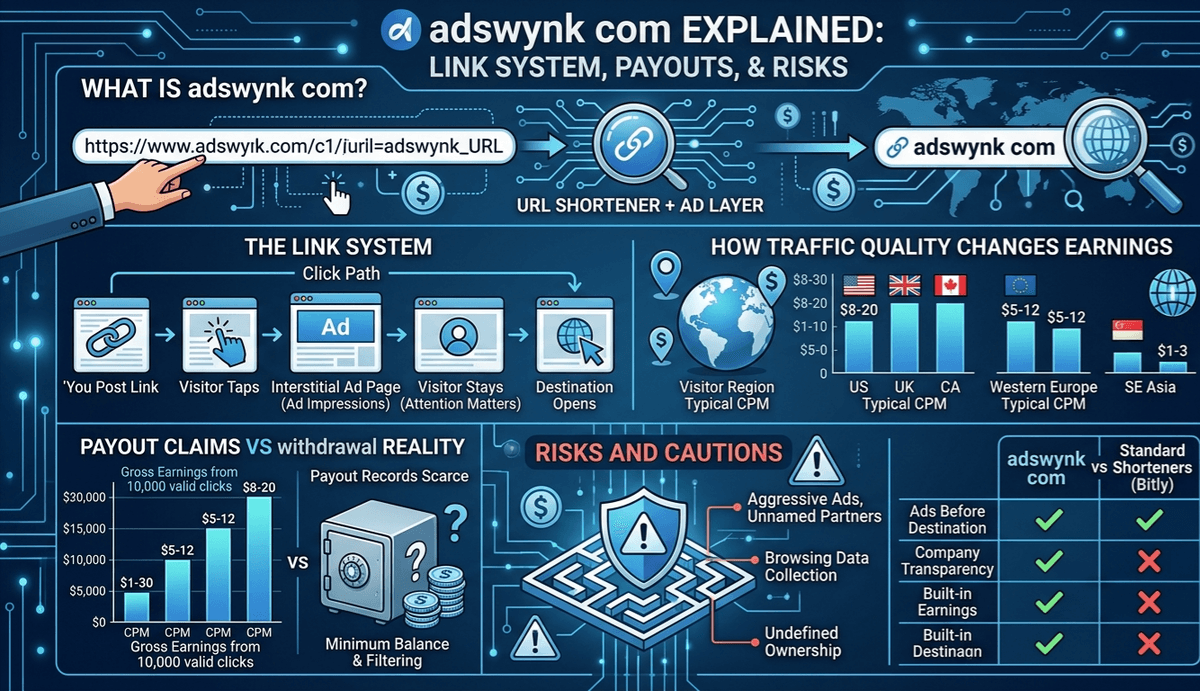
adswynk com keeps showing up in Facebook posts, YouTube descriptions and short clips promising quick payouts from shared links. The pitch is simple: paste a long web address, get a short one back, earn when people click.
Behind that pitch sits an ad-gated redirect system. Payment depends far more on who clicks than on how many clicks you collect.
What Is adswynk com and How the Link System Works
adswynk com is a URL shortener with an advertising layer attached. You submit a long address, the service returns a compact version, and anyone who taps it passes through an ad screen before the real page loads.
Advertisers pay for those impressions. A portion of that spend is credited to the account that created the link. AdFly and Shorte.st ran the same model years ago. What changed is distribution, since most short links now travel through social feeds rather than forums.
The Click Path on adswynk com Links
You post the link. Someone taps it. An interstitial ad page holds them for a few seconds. A continue button appears. Only then does the destination open.
| Recorded at each step | Why it matters |
|---|---|
| Visitor count | Sets the base figure for any payment |
| Ad impressions | What advertisers are actually buying |
| Time on the ad screen | Fast exits often count for nothing |
| Country of origin | Decides the rate applied to the click |
| Click behaviour | Repeated patterns trigger bot filters |
Can adswynk com Actually Pay You?
Rates run on CPM, meaning payment per thousand views, and CPC, meaning payment per click. Volume alone does not decide your total. Geography does most of the work.
How Traffic Quality Changes adswynk com Earnings
| Visitor region | Typical CPM |
|---|---|
| US, UK, Canada | $8–20 |
| Western Europe | $5–12 |
| Gulf and East Asia | $3–8 |
| South and Southeast Asia | $1–3 |
| Unclassified or filtered | under $1 |
Indicative CPM ranges published across ad-based URL shorteners. adswynk com has not released a verified rate card.
One visitor from a tier-one country can outpay a hundred from a low-rate region. Bot detection strips suspected invalid traffic before anything is credited, so a thousand weak taps can settle at close to zero.
Attention on the ad screen matters as much as the click itself. Anyone sending traffic at scale should get used to reading traffic reports properly before drawing conclusions from a dashboard total.
adswynk com Payout Rules and Withdrawal Reality
| CPM rate | Gross earnings from 10,000 valid clicks |
|---|---|
| $1 CPM | $10 |
| $3 CPM | $30 |
| $8 CPM | $80 |
| $15 CPM | $150 |
Gross earnings from 10,000 valid clicks at four CPM rates. Filtered clicks are removed before this calculation.
The cash-out script follows the category: a minimum balance, PayPal or crypto transfers, weekly or monthly release. Evidence is where it thins out. Confirmed transaction records and payout screenshots are hard to find, and similar services attract complaints about delays tied to traffic quality.
Compare that with creator payout systems that publish their withdrawal rules, and the gap in documentation becomes obvious.
Is adswynk com Safe and Legit?
Anything built on redirects, unnamed ad partners and click tracking carries exposure. Aggressive ad creatives, browsing data collection and third-party jumps all come with the format. None of that proves harm, but it does justify caution.
Ownership is undisclosed, company records are scarce and user reports conflict. The same questions apply to any income offer that may be a funnel rather than a real payer, and to lookalike domains built on typo traffic.
Ad gates also generate their own problems. Visitors hunt for ways around interstitial ad pages, and many end up on free web proxies with hidden costs. Both trends cut into what a link owner earns.
adswynk com Pros and Cons
| Working in its favour | Working against it |
|---|---|
| Short links are easy to create and share | Ownership and company details stay hidden |
| No website or approval process needed | Payout consistency is barely documented |
| Basic click tracking is included | Income rests entirely on ad networks |
| Free to start testing | Earning claims circulating online look inflated |
adswynk com vs Bitly and Standard URL Shorteners
| Point | adswynk com | Bitly |
|---|---|---|
| Link shortening | Yes | Yes |
| Ads before destination | Yes | No |
| Built-in earnings | Claimed | None |
| Company transparency | Weak | Established |
| Reporting depth | Basic | Detailed |
Who Should Test adswynk com and Who Should Skip It
Curious creators with spare traffic can run a small test without much downside. Keep personal details minimal, watch how genuine your visitors look, and treat any balance as unconfirmed until money lands.
Anyone expecting stable passive income should look elsewhere. Programmes like TikTok affiliate commissions at least come with published terms, and basic account security habits matter more once you start posting redirect links at volume.
FAQs
What is adswynk com used for?
adswynk com shortens long web addresses and shows an advertisement before the visitor reaches the destination page. The account that created the link earns a share of revenue from valid ad views and clicks.
Does adswynk com really pay?
Payment is possible in principle, but verified transaction records are scarce. Earnings depend on visitor location, time spent on the ad screen, and whether bot filters accept the traffic as valid.
Is adswynk com safe to use?
Risk sits at moderate. The service depends on third-party ad networks, redirects and click tracking, and ownership details are not published. Share no personal data and treat any balance as unconfirmed.
How much does adswynk com pay per 1,000 clicks?
No verified rate card exists. Ad-based shorteners generally pay most for visitors from the US, UK and Canada, and far less for low-rate regions or traffic with no identified source.
Is adswynk com better than Bitly?
They solve different problems. Bitly handles clean tracking and branded links with no ads. adswynk com adds monetisation without published transparency, which suits casual testing rather than business use.
Final Verdict on adswynk com
adswynk com sits in the grey strip between a link shortener and a traffic-cashing service. Testing it costs little. Planning around it is the mistake, because steady payment records are the one thing this category rarely produces.