What Happens Behind the Scenes When You Generate an AI TikTok Voice

Maxime Dupré
9/1/2026
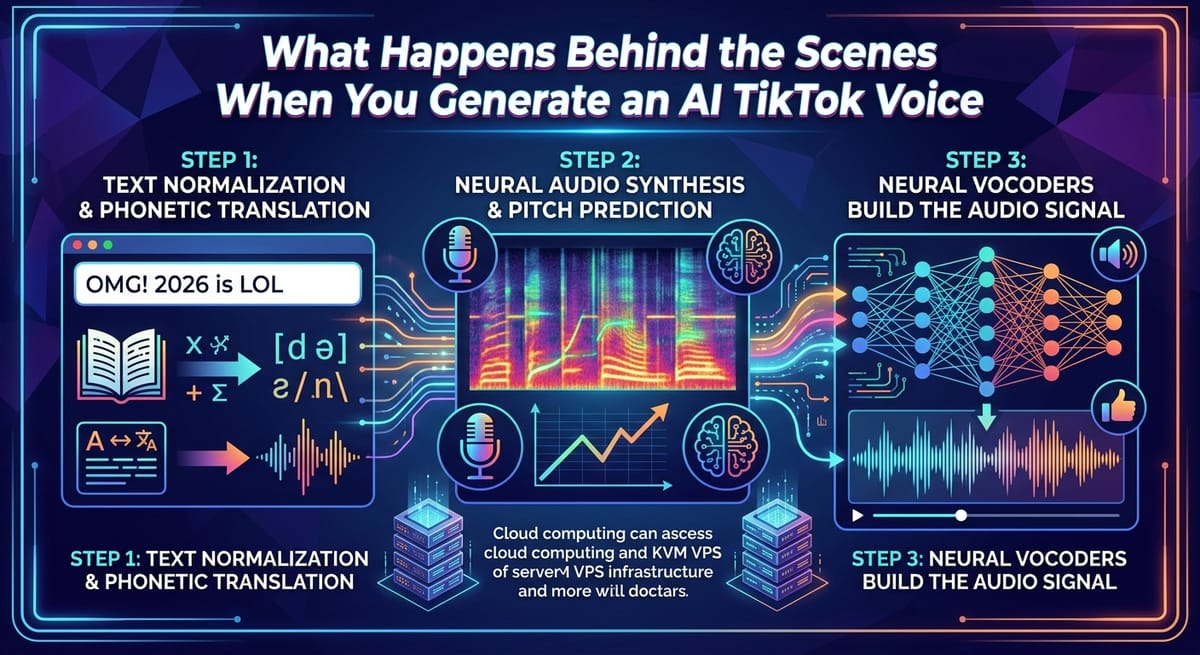
As you flip through your feeds on TikTok, you will find many different and expressive AI voices reading stories, memes, and product instructions. All you have to do is to write your captions and click a single button and you get your text narrated in a human-like manner. It may seem easy but actually a lot of technology works behind the scenes..
We examine what actually occurs behind the scenes when you generate an AI TikTok voice, tracking your words from raw text to finished audio.
Step 1: Text Normalization and Phonetic Translation
Your input text does not go straight to an audio generator. First, deep learning models analyze your written words through text normalization.
The AI needs to transform numbers, acronyms, and symbols into phonetic speech. As such, if you enter “2026,” the AI will say “twenty twenty-six.” On the other hand, when you use “LOL,” the AI will determine based on the context whether to spell it out or produce laughter.
Then, using the grapheme-to-phoneme (G2P) engine, the words are converted into their phonetic counterparts, which are the basic units of human speech. In this case, punctuation marks are very important because commas add milliseconds of pauses while question marks change the pitch contour to form cadence.
Step 2: Neural Audio Synthesis and Pitch Prediction
After this stage of transforming the text into phonetic tokens, the acoustic models step in. Modern platforms model natural rhythm, stress, and intonation of spoken language.When it comes to handling large amounts of audio requests immediately, the creators and developers need cloud-based infrastructure. This is especially important if your custom voice models and complex rendering pipelines require high-performing remote servers. A reliable option like a buy kvm vps gives you dedicated compute power to generate audio without unexpected lag or throttling.
During this stage, the acoustic model creates a spectrogram—a visual map representing frequencies and sound intensity over time.
Step 3: Neural Vocoders Build the Audio Signal
The spectrogram is nothing more than a visual representation; it cannot be played back as audible sound. The true magic occurs in the neural vocoder.
The vocoder takes the complicated mathematical representations of frequencies and transforms them into the actual waveform data. It builds the minutest details of the voice, such as breath sounds, vocal resonances, and warm tones. Modern vocoders perform these calculations in milliseconds.
The Infrastructure Reality
The seamless voiceover experience relies on three distinct elements working in sequence:
Text Processing.Converting written characters into structured phonetic guides.
Acoustic Prediction. Calculating pitch variations, pauses, and emotional tone.
Neural Rendering. Synthesizing final audio files via high-speed server hardware.
The next time you generate an AI voiceover on TikTok, you are interacting with complex neural networks that turn static text into natural speech in a fraction of a second.