Small Niche, Big Business

Maxime Dupré
10/19/2026
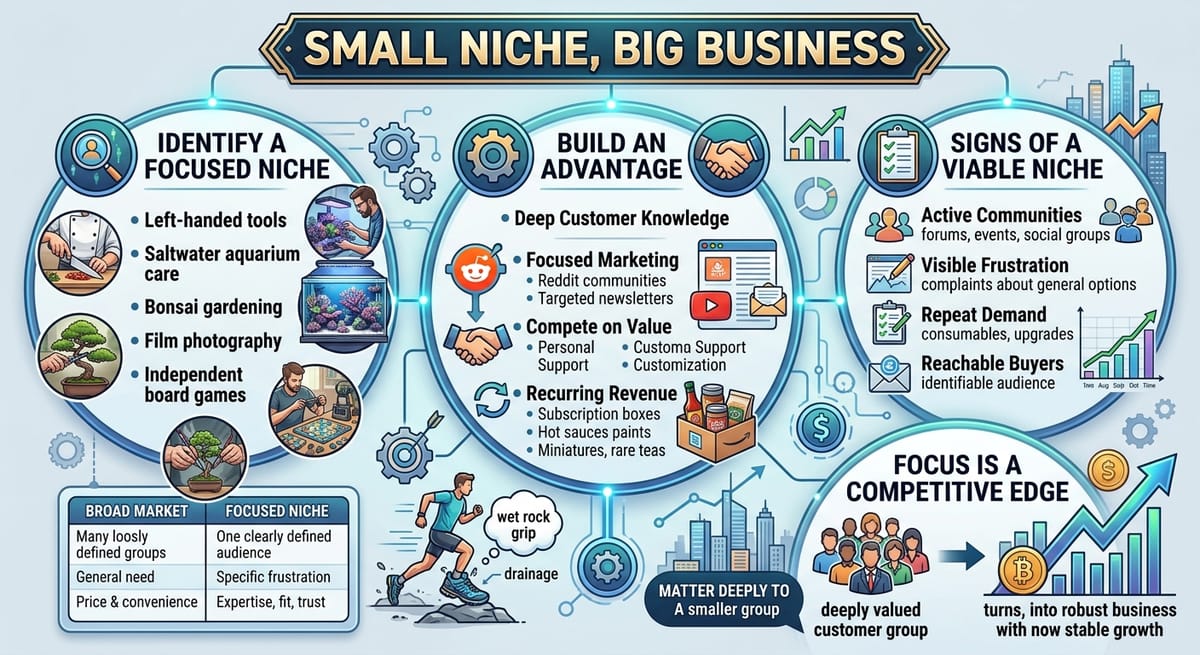
Some profitable businesses begin by serving a group so specific that larger companies barely notice it. A shop specializing in left-handed kitchen tools, a service restoring vintage typewriters, or a brand making clothing for unusually tall cyclists may never appeal to everyone. That is exactly the point.
A narrow market gives a smaller company room to become highly relevant to the right customers. Instead of competing for the largest possible audience, the business solves a problem that broad retailers often handle poorly.
Why Narrow Markets Can Be Easier to Win
When a company tries to appeal to everyone, it competes with businesses that have bigger marketing budgets, wider inventories, stronger logistics, and lower prices. A new company rarely has an advantage on those terms.
A niche changes the basis of competition. Someone maintaining a saltwater reef aquarium, for example, may prefer a specialist that understands water chemistry, coral compatibility, lighting, and reef-safe products rather than a generic pet store. That expertise can reduce price competition because the customer is buying confidence as well as the product.
Specialist information businesses can work the same way. Instead of covering an entire industry, a site may focus on a narrow group of questions and build expertise around them. In gambling, for example, that might include explaining offers such as the mr bet no deposit bonus for readers already comparing casino promotions. The audience may be smaller, but it is also more focused, which can make the business easier to position and monetise. That same advantage becomes clear when broad and niche businesses are compared across a few basic questions:
| Business question | Broad market | Focused niche | Why it matters |
|---|---|---|---|
| Who is the customer? | Many loosely defined groups | One clearly defined audience | Messaging becomes easier to target |
| What problem is solved? | General need | Specific frustration or use case | The offer feels more relevant |
| What drives the purchase? | Often price and convenience | Expertise, fit, trust, availability | Businesses have more ways to differentiate |
| What is the main risk? | Heavy competition | Market may be too small | Demand must be tested early |
A small niche is not automatically a good business. Lower competition means little if only a few people are willing to pay. The strongest niches combine specificity with enough recurring demand to support the company.
How Niche Businesses Build an Advantage
A focused company becomes stronger when it turns audience knowledge into something larger competitors cannot easily reproduce. That insight can shape better products, sharper messaging, and a more relevant customer experience.
Deep Customer Knowledge
Niche founders often understand the problem from experience. A trail runner selling specialist footwear knows that grip on wet rock, toe protection, drainage, and long-distance fit matter differently from features in a normal road shoe. That insight shapes product selection, customer support, and marketing.
More Focused Marketing
Broad advertising often pays to reach people who will never buy. A niche brand can focus instead on places where potential customers already spend time.
That might mean a specialist Reddit community, industry newsletter, trade event, YouTube channel, hobby forum, or tightly defined search query. A bonsai store does not need every gardener. It needs people already looking for bonsai tools, pots, soil, or care advice.
More Room to Compete on Value
Price matters less when customers cannot easily find an equivalent product elsewhere. Specialist sellers can compete through expertise, unusual inventory, personal support, or customisation rather than simply trying to be the cheapest.
Small Markets Can Grow Into Serious Categories
Some niches expand because the underlying interest becomes more popular. Others remain relatively small but stay profitable because customers buy repeatedly.
Subscription businesses show how narrow interests can support recurring revenue. Boxes can focus on hot sauces, specialty coffee, miniature painting supplies, rare teas, or independent board games.
The same pattern appears in adaptive clothing, wide-fit footwear, reptile supplies, film-photography equipment, and specialist online education. Each starts with a more precise problem than simply “sell clothes” or “teach a skill.”
This is where niche businesses can become surprisingly resilient. A company does not need millions of customers if a smaller group buys regularly, recommends the brand, and sees it as the obvious specialist in its category.
How to Tell Whether a Niche Can Support a Business
Specificity is useful only when demand exists. Before investing heavily, look for evidence that people already care enough to spend money. Useful signals include:
Active communities: Forums, events, social groups, and newsletters show lasting interest.
Visible frustration: Repeated complaints about quality, selection, or service can reveal an opening.
Repeat demand: Consumables, maintenance, upgrades, and new releases can bring customers back.
Reachable buyers: A clearly identifiable audience makes marketing easier.
A niche with enthusiasm but little purchasing activity may work better as a side project than a full business. Demand matters more than the number of people who simply say they like the idea.
Focus Can Be a Competitive Advantage
A small niche can become a real advantage. It can give a business something larger competitors often struggle to achieve: a precise understanding of who the customer is and why they buy.
The strongest niche companies do not succeed simply because competition is low. They find a specific group with a real problem, prove that the group spends money, and build enough expertise and trust to become a clear choice within that category. Growth can come later. First, the business has to matter deeply to a smaller group of customers.