Math in Nature: Fascinating Patterns and Numbers

Maxime Dupré
1/21/2026
Math in Nature: Fascinating Patterns and Numbers
Where Math Meets the Outdoors
Nature is full of patterns that repeat, branch, and curve in ways that look almost designed. Math gives names and tools for these shapes so they can be described, compared, and measured.
In Short, Patterns are clues about simple rules running behind complex scenes. Spotting a pattern is often the first step toward explaining it.
Symmetry: Nature’s Shortcut for Strength
Symmetry means that one side matches the other after a flip, turn, or slide. Animals often show left-right symmetry because a balanced body can move, sense, and grow more smoothly. Many plants use radial symmetry, where parts repeat around a center, because it helps them face light and pollinators from many directions.
The easiest way to spot symmetry outdoors is to imagine a mirror line down the middle of a leaf or an insect. Another quick check is rotation: turn a flower head a little and see whether it still looks the same.
Probability and the Bell Curve: Order From Random Drops
Some patterns appear when a process is repeated many times, even if each single result is hard to predict.
For a simple example, Plinko games show how a dropped ball bounces left and right through pegs, and the most common landing spots pile up near the middle. In nature, the same idea helps explain why measurements like height, seed size, or small errors often cluster around an average rather than spread evenly.
- Human Traits: Many body measurements cluster around typical values, with fewer people at the extremes.
- Plant Variation: Leaves on the same tree tend to be similar in length, with small natural differences.
- Measurement Noise: Repeating a careful reading (like a temperature) often produces values near the center more than far away.
- Mixing and Diffusion: Random motion can create smooth, predictable spreads instead of sharp edges.
How To Spot Fibonacci Spirals in Living Things
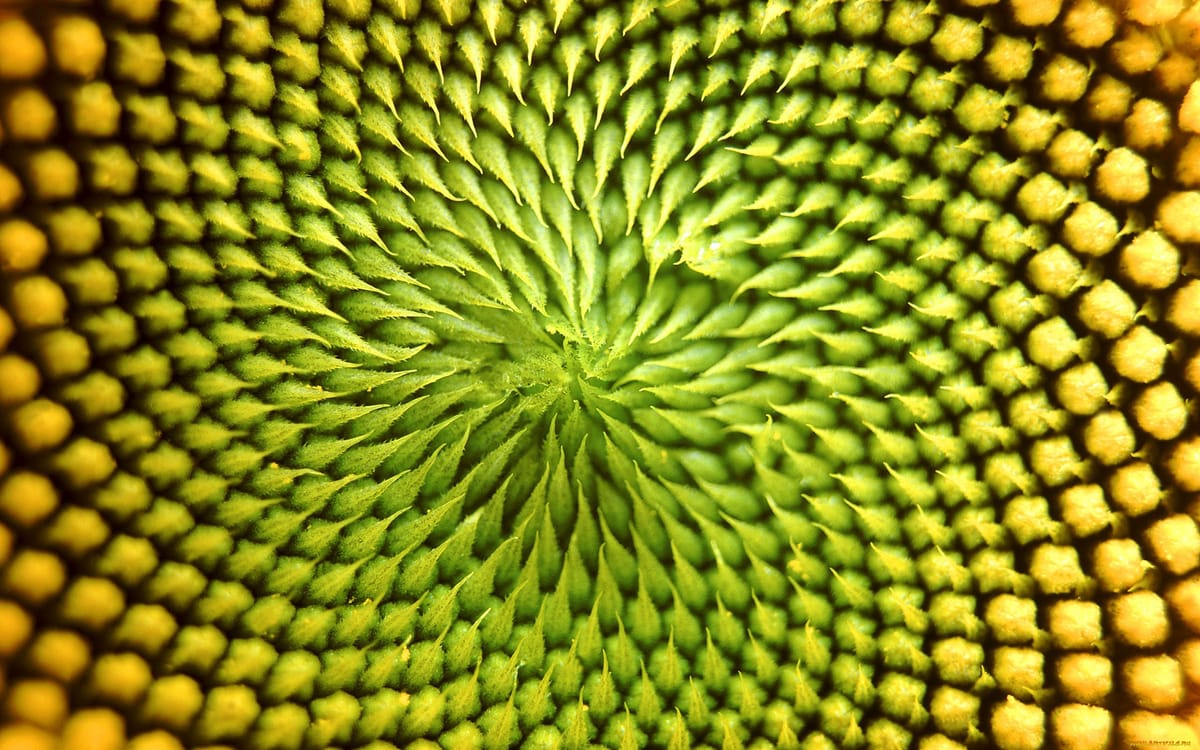
The Fibonacci sequence (1, 1, 2, 3, 5, 8…) is famous because nearby numbers add up to make the next one. In many plants, spiral counts in opposite directions often match Fibonacci numbers because this packing method helps fit parts tightly without large gaps.
Spiral Packing in Plants
Sunflowers, pinecones, and pineapples can show two sets of spirals crossing each other. Counting each direction may reveal pairs like 34 and 55 or 8 and 13, though real living systems can vary.
Spirals Beyond Plants
Spiral growth can also appear in shells and horn shapes because adding material outwardly can maintain the overall form. Larger spirals show up in storms and galaxies, where rotation and gravity shape swirling arms.
Key Takeaway: A spiral pattern often points to efficient growth and packing under simple constraints. The counts do not have to be perfect for the idea to hold.
Fractals and Self-Similarity: Big Patterns in Small Places
A fractal is a shape that looks similar at different sizes, like a branching pattern repeating within itself. Ferns, Romanesco broccoli, lightning, and some coastlines can look more fractal-like the closer the view gets. These patterns often form when the same growth or erosion rule repeats itself step by step.
| Pattern Type | What It Looks Like | Common Examples | Math Idea |
|---|---|---|---|
| Symmetry | Balanced halves or repeated rotations | Butterflies, starfish, and many flowers | Transformations (flip, turn) |
| Spirals | Curves that wind around a center | Sunflower heads, shells, storms | Growth plus rotation |
| Fractals | Similar shapes at different scales | Ferns, branching trees, coastlines | Repeated rules (iteration) |
Seeing Patterns Without Losing the Wonder
Learning the math behind patterns does not drain away beauty; it adds a new layer of meaning. Symmetry, spirals, and fractals show that small rules can build large designs, even in messy environments. The next walk outside can become a quiet scavenger hunt for shapes hiding in plain sight.
Next Step: Pick one pattern type and try to photograph three examples in a single day. Add a short note about what repeats and what changes.