Life After 30 for Pro Athletes

Maxime Dupré
10/19/2026
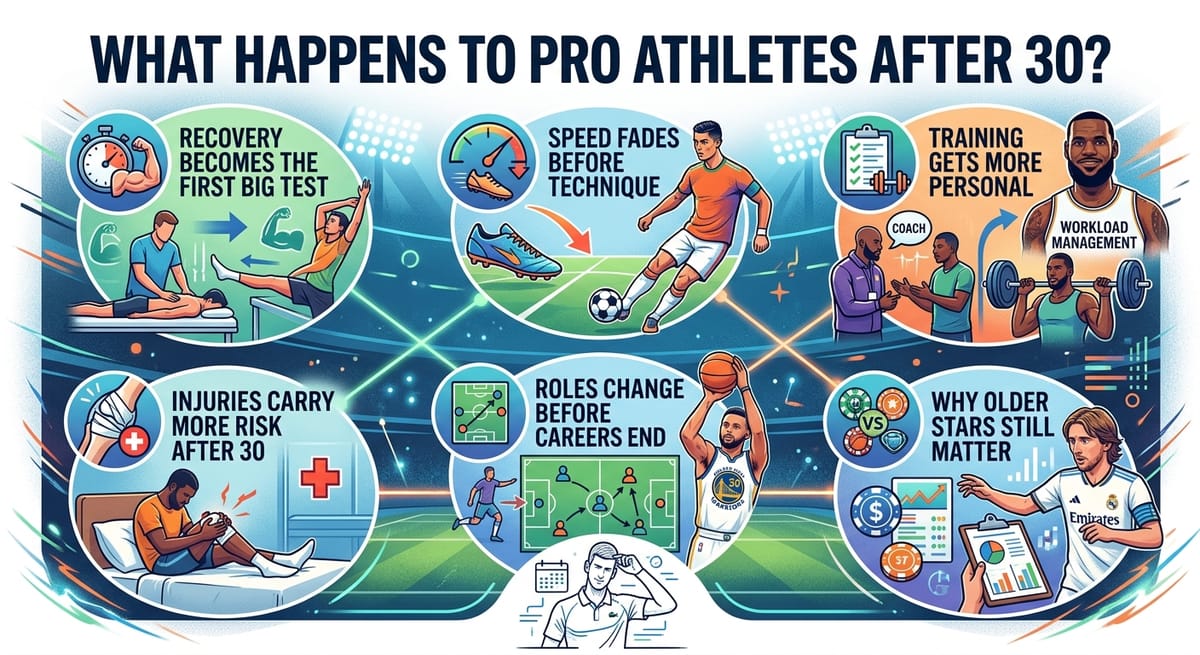
Thirty can be a strange age in professional sport. One athlete starts losing minutes, another signs a new contract, and someone else produces one of the best seasons of his career. LeBron James is still playing in the NBA at 41, Luka Modrić remains active with Milan at the same age, and Stephen Curry is still producing at 38.
Age matters, but it does not affect every athlete in the same way. The real question is which parts of performance decline first and how well a player adapts once that starts happening.
Recovery Becomes the First Big Test
For many professionals, recovery changes before their basic skill level does. A 24-year-old may play, travel, train hard, and be ready again within a few days. At 34, that same schedule can demand more treatment, more sleep, and much tighter control over training intensity. This is why veteran routines often look different:
- fewer unnecessary high-intensity sessions;
- more physiotherapy and mobility work;
- longer recovery between matches;
- individual training programs;
- more careful management of existing injuries.
Cristiano Ronaldo shows how elite athletes can extend their careers by changing how they play and manage their workload. As players get older, recovery, positioning, and selective effort often become more important than relying on constant explosive movement.
Speed Fades Before Technique
Not every sporting skill ages at the same rate. Explosive acceleration, reaction speed, and repeated sprinting are usually harder to preserve than passing, shooting technique, positioning, or decision-making. That is why some positions and sports allow much longer careers than others.
Ronaldo’s own game changed noticeably over time. Earlier in his career, he was known for explosive runs from wide areas. Later, he became more focused on movement inside the penalty area, timing, positioning, and finishing.
Luka Modric offers a different case. His game has never depended mainly on sprint speed. Reading space, controlling tempo, and choosing the right pass can remain useful even when physical explosiveness starts to decline.
Training Gets More Personal
Veterans rarely follow exactly the same program as younger teammates. Coaches may reduce gym volume, limit repeated sprint work, or give older players more recovery between demanding sessions. Some footballers skip parts of team training before important matches. Tennis players may reduce their tournament schedule instead of playing every available event.
LeBron James is one of the clearest examples of long-term workload management. As his NBA career progressed, maintaining availability became just as important as adding more training.
The principle is simple. Older athletes often stop asking, “How much can I do?” and start asking, “How much do I actually need?”
Why Older Stars Still Matter in Fantasy Sports and Betting
Established athletes can remain highly relevant to fantasy sports and betting because they often have predictable roles, significant playing time, and a long performance history that gives fans more information to work with.
Sportsbooks such as xonbet casino may offer markets on major teams, competitions, and well-known athletes. When evaluating an older player, bettors often look beyond age and consider recent form, fitness, minutes, opponent quality, and expected role.
Fantasy managers make similar assessments. A famous 35-year-old may still be valuable if he starts regularly and produces consistently, while a younger player with more physical potential may receive fewer minutes. Reputation still matters, but current form, fitness, and role are better indicators of present value.
Injuries Carry More Risk After 30
A major injury at 22 and the same injury at 35 create very different career questions. Younger athletes usually have more time to recover, rebuild fitness, and return to their previous level. Older players have less margin for error, especially when contracts are short and recovery takes longer.
Teams also become more cautious. They have to consider salary, playing time, rehabilitation, and the chance that the same problem returns. This is one reason durability becomes so valuable after 30. Staying available can be almost as important as producing occasional brilliant performances.
Roles Change Before Careers End
Many long careers survive because the athlete accepts a different role. A football winger may move centrally. A midfielder may play deeper. A basketball star may reduce minutes or depend more on shooting. A tennis player may enter fewer tournaments and focus on the biggest events.
Stephen Curry is a good example of a skill set that can age differently from one built mainly around explosive drives. Shooting range, movement without the ball, and decision-making can remain dangerous even when raw athleticism starts to fall. Not every veteran needs to remain the main star. Some become specialists, leaders, or reliable options in specific situations.
Why Some Athletes Last Much Longer
There is no single age when a professional athlete becomes “old.” Sport, position, injury history, genetics, workload, playing style, and motivation all matter. So does the willingness to change.
The athletes who last longest rarely stay exactly the same. Ronaldo changed where he attacked from. Modric relied on intelligence and control. Djokovic adjusted his schedule and match management. LeBron learned to manage an enormous career workload.
Turning 30 does not decide when a career ends. It simply makes adaptation harder to avoid. For some pros, that leads to rapid decline. For others, it starts a second version of the same career.