icryptoxcom Using Machine Learning For Crypto Trading In 2026

Maxime Dupré
4/16/2026
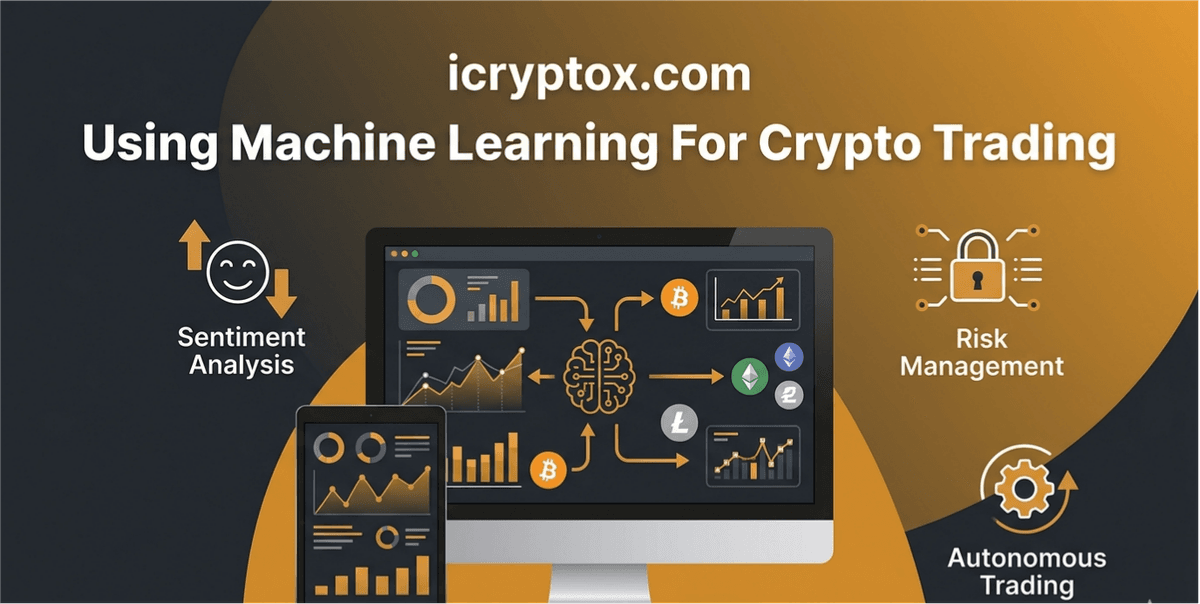
icryptox.com Using Machine Learning For Crypto Trading In 2026
Cryptocurrency markets don't pause. Price changes happen in milliseconds, and any trader relying on manual analysis will miss more than they catch. icryptox.com addresses this through a machine learning system that reads market data, identifies patterns, and executes trades autonomously. This covers how those systems work, what performance data shows, and how the platform handles risk and compliance.
How icryptox.com Machine Learning Reads Crypto Markets
icryptox.com uses both supervised and unsupervised learning to analyze market activity. Supervised learning processes historical price and volume data to predict future movements. Unsupervised learning finds hidden patterns in new market data without preset parameters — the kind rule-based systems would miss entirely.
The core framework combines time series modeling, regression analysis, and classification algorithms. Base prediction accuracy sits between 52.9% and 54.1% across different cryptocurrencies. Filtered to high-confidence predictions, that rises to 57.5%–59.5%. The platform also draws from on-chain records, social media, and news feeds to build the trading signals that power automated decisions.
Pattern Recognition and Price Forecasting in Crypto Trading
LSTM Networks, GRU Models, and Technical Indicators
Long Short-Term Memory (LSTM) networks and Gated Recurrent Unit (GRU) models handle price forecasting on icryptox.com. These models analyze 23 candlestick patterns and six technical indicators — Bollinger Bands, RSI, ULTOSC, and Z-Score calculations among them — at 4-hour data intervals. Deep neural network surrogate models average 68% prediction accuracy for asset returns, 17 percentage points above traditional time series methods.
Sentiment Analysis for Crypto Market Behavior
icryptox.com tracks Twitter/X, funding rates, large transaction activity, community mentions, and Google Trends data to read market mood before price moves. The system processes this unstructured data to flag whether sentiment is bullish, bearish, or neutral — a signal that feeds directly into automated trade decisions without any manual interpretation step.
Risk Management in Automated Crypto Trading
Stop-loss orders and position size limits define exposure boundaries. The platform evaluates market risk, credit risk, and operational risk on a continuous basis. A long-short ML portfolio has recorded an annualized Sharpe ratio of 3.23 after transaction costs — well ahead of a standard buy-and-hold strategy, which averages 1.33. For traders managing money across asset classes beyond crypto, structured investment frameworks offer a practical baseline for sequencing exposure decisions.
The Hierarchical Risk Parity (HRP) method handles portfolio protection through three steps: clustering assets by type, recursively splitting them to balance exposure, and applying quasi-diagonalization for risk assessment. The system analyzes 41 cryptocurrency features using daily price and market cap data.
Setting Up Automated Crypto Trading on icryptox.com
The platform processes up to 400,000 data points per second and executes trades within 50 milliseconds. Setup involves four stages: connecting API access to live market data, defining risk parameters and strategy rules, setting position sizes relative to account balance, and running backtests against historical data before going live.
Backtesting and Performance Optimization
Backtesting tests strategies against historical data to measure effectiveness before real capital is at risk. icryptox.com monitors over 500 trading pairs simultaneously and records an average annual net return of 16.8% with a Sharpe ratio of 1.65 after transaction costs.
Institutional and Retail Performance Results
Five ML models applied to Ethereum and Litecoin recorded annualized Sharpe ratios of 80.17% and 91.35% respectively. Yearly returns reached 9.62% for Ethereum and 5.73% for Litecoin after costs.
Retail traders access the same systems. Automated methods now handle 60%–73% of US equity trades; icryptox.com makes those tools available to individual traders. During upward-trending markets, yearly returns reached 725.48%. Sideways markets showed -14.95% — a realistic picture of what automated trading delivers under different conditions.
| Market Condition | Annual Return | Sharpe Ratio |
|---|---|---|
| Upward-trending | 725.48% | 3.23 (ML portfolio) |
| Sideways | -14.95% | — |
| Ethereum (post-cost) | 9.62% | 80.17% |
| Litecoin (post-cost) | 5.73% | 91.35% |
| Average annual net | 16.8% | 1.65 |
Machine Learning Fraud Detection and Crypto Compliance
ML clustering algorithms identify blockchain addresses with similar behavior patterns, flagging suspicious networks automatically. The system caught a GBP 79.42 million crypto theft and a GBP 1.59 million NFT scam in 2023. EU rules that took effect in December 2024 require crypto-asset service providers to demonstrate strong control systems — icryptox.com's ML infrastructure watches transactions and flags potential regulatory breaches before they escalate.
Spotting anomalous behavior before it becomes a problem is a challenge shared across data-driven platforms. Data analytics tools built around early pattern detection apply a comparable approach to enterprise intelligence and security monitoring.
2026 Market Outlook for AI-Driven Crypto Trading
AI-crypto sectors are outperforming standard portfolios during extreme market conditions. DeFi grew 120% in total value locked. The real estate token sector recorded an 82% market cap increase. Technology sectors including Generative AI, AI Big Data, and Cybersecurity all posted improved returns and market efficiency. icryptox.com continues building tighter models, faster processing, and stronger compliance tools alongside that growth.
For context on how newer tokens are structured and valued, the Milohacherry Coin tokenomics breakdown illustrates how ML-driven platforms evaluate and engage with early-stage crypto assets.
FAQs
What prediction accuracy does icryptox.com machine learning achieve?
Base accuracy ranges from 52.9% to 54.1% across most cryptocurrencies. High-confidence predictions reach 57.5%–59.5%. Deep neural network models average 68% for asset return prediction.
How fast does icryptox.com execute automated trades?
The platform processes up to 400,000 data points per second and executes individual trades within 50 milliseconds.
What is the Sharpe ratio for icryptox.com's ML portfolio?
The long-short ML portfolio records an annualized Sharpe ratio of 3.23 after transaction costs, compared to 1.33 for a standard buy-and-hold strategy.
Does icryptox.com work for retail traders or only institutions?
Both. The same ML systems are available to individual traders. During upward-trending markets, retail-facing strategies recorded yearly returns of 725.48%.
How does icryptox.com detect crypto fraud?
ML clustering algorithms group blockchain addresses by behavior to flag suspicious networks. The system identified a GBP 79.42 million crypto theft and a GBP 1.59 million NFT scam in 2023.